One of the biggest advantages of an above ground pool is how quickly it goes from purchase to swimming. While an inground pool takes 8 to 12 weeks to build and a concrete pool can stretch to 6 months, most above ground pools are fully installed and ready to fill within 1 day. For families in Texas, Oklahoma, and Arkansas who want a pool this season, not next, that timeline matters.
But “quick installation” doesn’t mean simple. Knowing what the process looks like helps you choose the right yard location, ask the right questions, and make sure your installation day runs smoothly.
Here is what happens from the moment the crew arrives until you get in.
Step 1: Site Selection and Ground Prep
Before anything goes up, the ground has to be right. The installation team will clear the selected area of all grass, roots, rocks, and debris, then excavate and level the ground to an even grade. High spots are dug down rather than filled in, because compacted native soil is more stable than filled soil under a pool’s weight.
This step matters more than most buyers expect. An unlevel base, even a few inches off across the pool’s diameter, causes uneven stress on the walls, liner stretching, and structural problems over time. All paver footplates need to sit within 1/8 inch of each other. It’s the most precision-intensive part of the entire job.
Once the ground is level, a sand base is spread across the pool footprint, smoothed out, and prepared to receive the liner.
Step 2: Track, Wall, and Frame Assembly
With the ground prepped, the team lays the bottom track around the marked circumference and sets a paver under each foot plate. The pool wall is then rolled out and seated into the track, secured, and bolted closed at the seam.
Uprights and top brackets are attached to stabilize the wall as it goes up. Getting the wall seated evenly around the entire track is critical. Any gaps or misalignments create problems when the liner and water go in.
Step 3: Sand Cove and Floor Smoothing
Before the liner drops in, the crew shapes a sand cove along the interior base of the wall, a sloped mound that rises about 10 inches up the inside of the pool wall. This supports the liner at the wall-floor junction and reduces stress on it over time, extending liner life.
The entire pool floor is then smoothed out by hand with a wide trowel. The smoother the floor, the cleaner and more wrinkle-free the liner will sit once water weight presses it down.
Step 4: Liner Installation
The liner is set into the pool and hooked into the wall track, working around the circumference. A liner that has been warming in the sun beforehand is noticeably easier to work with. Warm vinyl stretches more smoothly and leaves fewer wrinkles than a cold, stiff liner.
Step 5: Filling, Equipment, and Finishing
Water goes in as the liner is adjusted and any remaining wrinkles are worked out by hand. While the pool fills, the crew attaches the top rails, brackets, and caps around the perimeter, then mounts the skimmer and cuts the equipment holes.
Once the pool is at least halfway full, the outside is backfilled. The water weight inside holds the wall stable during this step. Backfilling too early can push the wall inward.
The ladder goes on last, but should not be placed in the pool for at least three days. The liner needs time to settle fully against the sand floor before taking concentrated weight from ladder feet.
What Above Ground Pool Installation Looks Like in Practice
For a typical round or oval above-ground pool on a reasonably flat yard, installation runs one to three days. Most of that time is ground preparation and leveling. The assembly itself moves quickly once the base is right.
A few things can extend the timeline: a significant slope in the yard, rocky or clay-heavy soil, oversized pools, or adding a deck around the pool at the same time. None of these is a deal-breaker. They’re worth discussing with a Galaxy design specialist before installation day, so there are no surprises.
What Galaxy Installs and Where
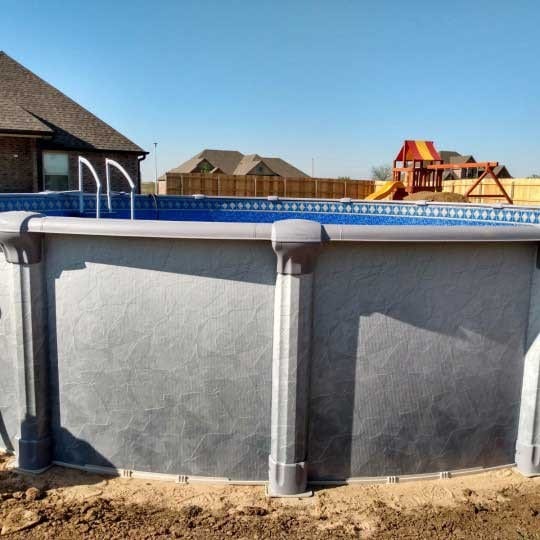
Galaxy Pool Spa Patio installs above ground pools across Texas, Oklahoma, and Arkansas, with an installation radius of 120 miles from each showroom. Available models include the Driftwood, Conquest, Delta, Destin, Panache, Regency, and Montana, in round and oval configurations across a range of sizes.
If you’re on a sloped lot or want a more permanent, inground-style appearance, Galaxy also carries Stealth semi-inground pools, which use the same steel panel and vinyl liner construction but are designed to be partially or fully buried. They’re worth comparing side by side when deciding between the two.
Frequently Asked Questions About Above Ground Pool Installations
How long does above ground pool installation take?
Most above ground pool installations are completed in 1 to 3 days. Site preparation (leveling the ground and laying the sand base) typically takes the most time. Pools on flat, already-prepared ground can be assembled in a single day with a good crew.
Does my yard need to be perfectly flat for an above ground pool?
Yes. The ground needs to be level to within 1/8 inch across all paver footplates. An unlevel base causes uneven wall stress and liner stretching over time. Slopes can be graded before installation, but significant inclines add time to site prep.
Do I need a permit for an above ground pool in Texas, Oklahoma, or Arkansas?
Permit requirements vary by city and county. Some municipalities require permits for pools above a certain depth; others do not. Check local building codes and HOA rules before installation. Galaxy’s design specialists can help point you in the right direction for your specific location.
How long does an above ground pool last?
With quality materials and consistent maintenance, above ground pools typically last 7 to 15 years. The liner will need replacement every 6 to 10 years, at a cost of roughly $2,000 to $5,000 depending on pool size and shape.
Can an above ground pool be installed on a slope?
Mild slopes can be graded before installation. Significant slopes are better suited to a Stealth semi-inground pool, which is specifically designed to handle uneven terrain and can be partially buried to follow the grade of the yard.
What is the difference between an above ground pool and a Stealth semi-inground pool?
An above ground pool sits on top of the ground on a leveled sand base. A Stealth semi-inground pool uses heavy-duty galvanized steel panels built to be partially or fully buried, delivering a more permanent, inground-style appearance. Both use a vinyl liner. The right choice depends on your yard, your budget, and how finished you want the final result to look. Galaxy carries both and can walk you through the comparison in person.
Want to See Your Above Ground Pool Options In Person?
Galaxy Pool Spa Patio has showrooms across Texas, Oklahoma, and Arkansas. Our design specialists can walk you through pool sizes, shapes, and the installation process for your specific yard. Financing is available with approved credit.
Want to learn more? Visit any one of our 5 locations to speak to one of our design specialists or shop our Above Ground Pools online.